The Via Tremola is one of the most beautiful scenic roads in Switzerland and part of the historic route across the Gotthard Pass. The old road lies on the southern side of the pass, where it winds down towards Airolo through a succession of tight hairpin bends. Much of the road is still paved with granite cobblestones, making the drive itself part of the experience. But I would not visit the Gotthard Pass just for the Via Tremola. The journey towards it is every bit as interesting. Approach from the north and you first drive through the dramatic Schöllenen Gorge, past the famous Teufelsbrücke and through Andermatt and Hospental before climbing into an increasingly bare Alpine landscape. If the weather is good and you have time to enjoy the drive, this is one of those routes where taking the slower road makes perfect sense. With stops along the way, you can easily spend several hours between Göschenen and Airolo. We certainly did and I would happily choose the same route again.
Read this article in DutchScenic drive over the Gotthard Pass and Via Tremola
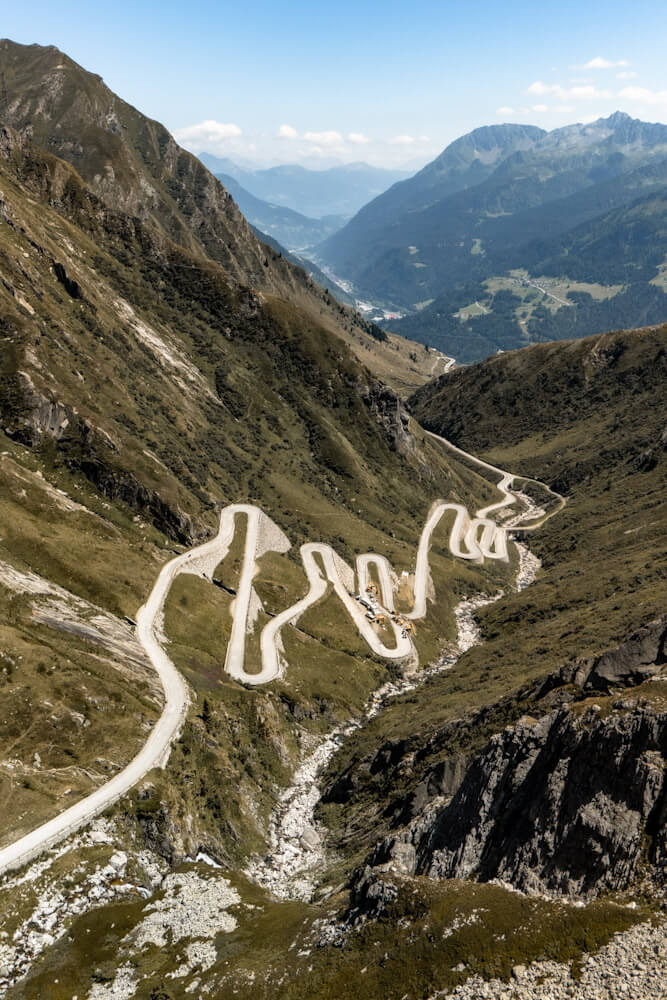
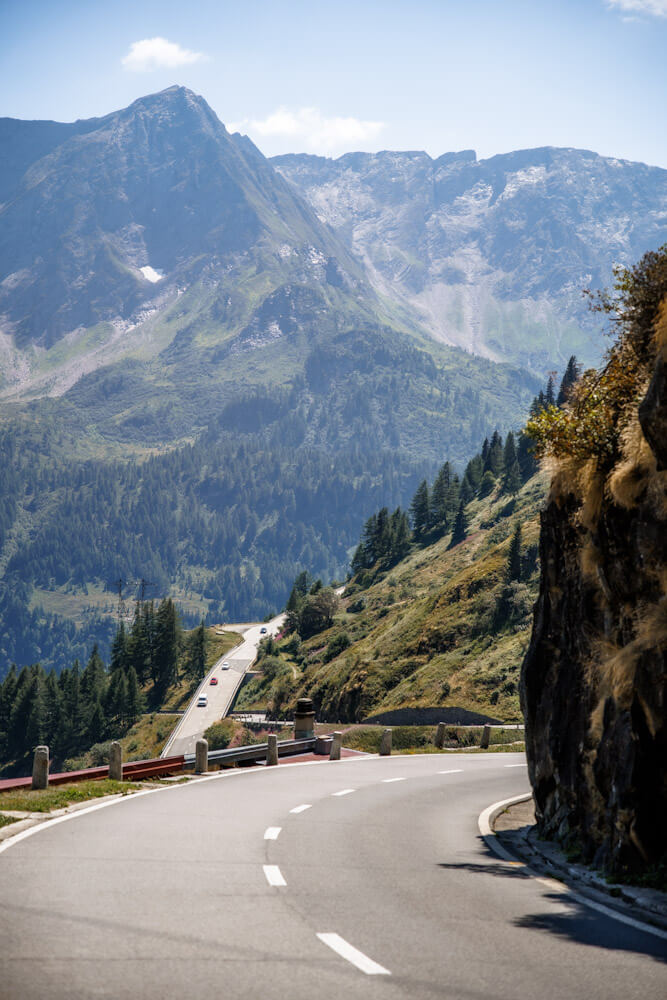
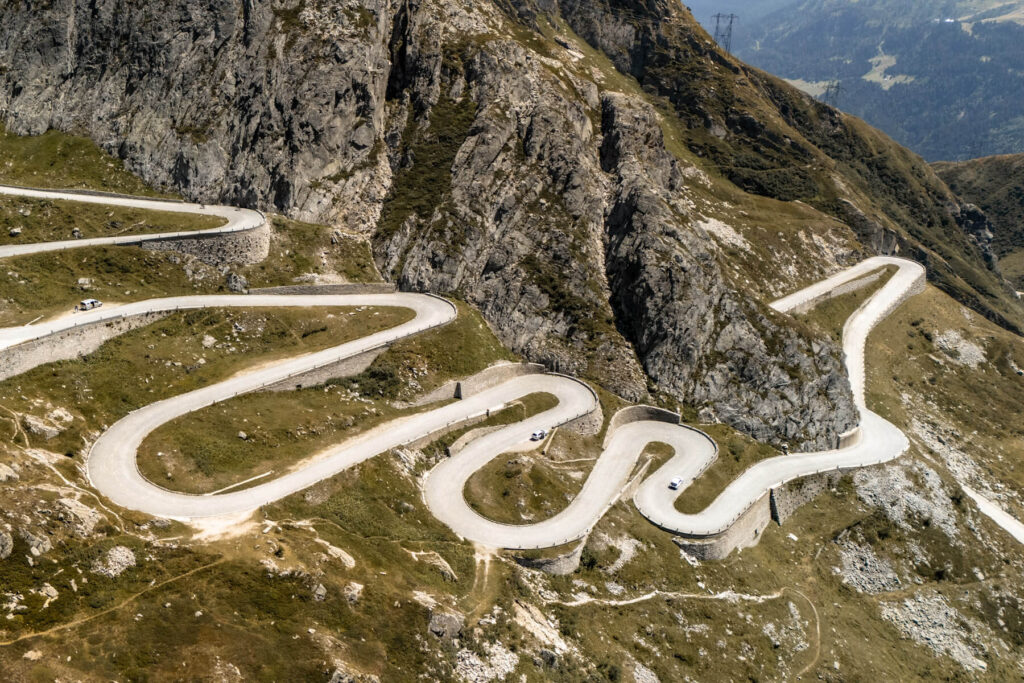
The Via Tremola itself is around four kilometres long, with 24 hairpin bends and a descent of roughly 300 metres. You can drive it in either direction, but I prefer travelling from north to south. This way, the scenery builds gradually. You begin among the steep rock walls of the Schöllenen Gorge before emerging into the wide valley around Andermatt. Beyond Hospental, the landscape becomes increasingly open, rocky and exposed as you climb towards the Gotthard Pass. Then comes the Via Tremola. From the upper section of the road, you can look deep into the Tremola Valley and see the hairpin bends unfolding below you. It feels like a fitting finale to the journey across the pass.
Schöllenen Gorge
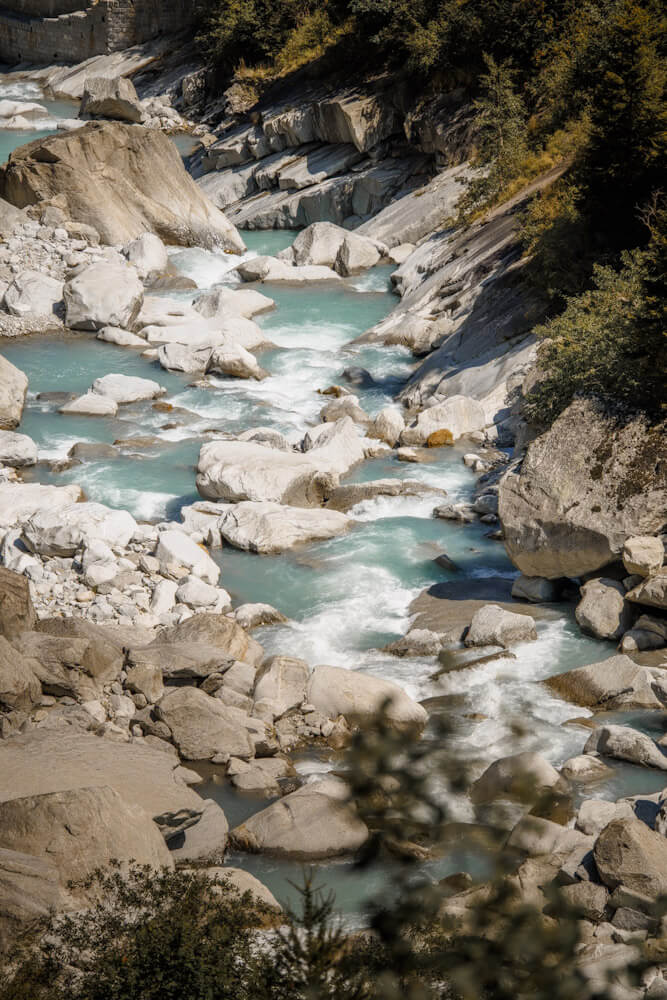
If you approach the Gotthard Pass from the north, leave the A2 at Göschenen and follow the signs towards Andermatt and the Gotthard Pass. The character of the journey changes almost immediately. Instead of disappearing into the Gotthard Road Tunnel, the road enters the Schöllenen Gorge. Here, the River Reuss has carved a deep passage between steep rock walls. For centuries, this narrow gorge was one of the most difficult obstacles for travellers crossing the Alps via the Gotthard. Even today, the landscape feels dramatic. The road, railway, river, old bridges and modern infrastructure all have to find their way through the same narrow gap between the mountains.
Häderlisbrücke
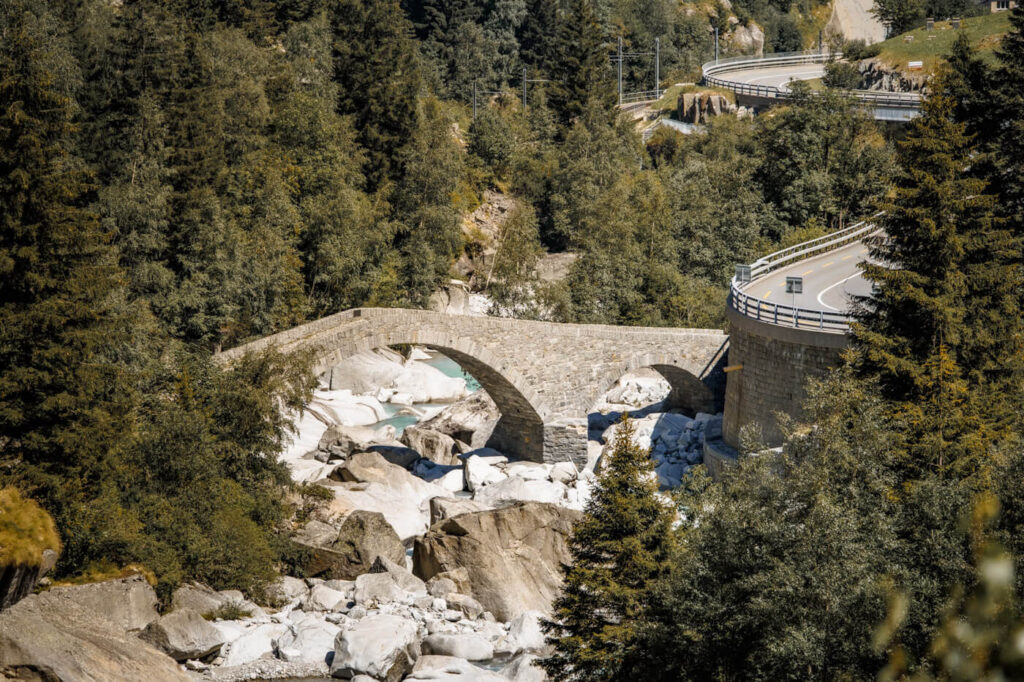
Not far beyond Göschenen, you pass the Häderlisbrücke, where it is worth stopping if you have the time. This stone arch bridge across the Reuss is part of the old Gotthard route and was originally built in 1649. The bridge you see today is a reconstruction. The historic bridge was destroyed during severe flooding in 1987 and rebuilt as faithfully as possible in 1991. Granite from the same quarry used for the original bridge was even used during the reconstruction.
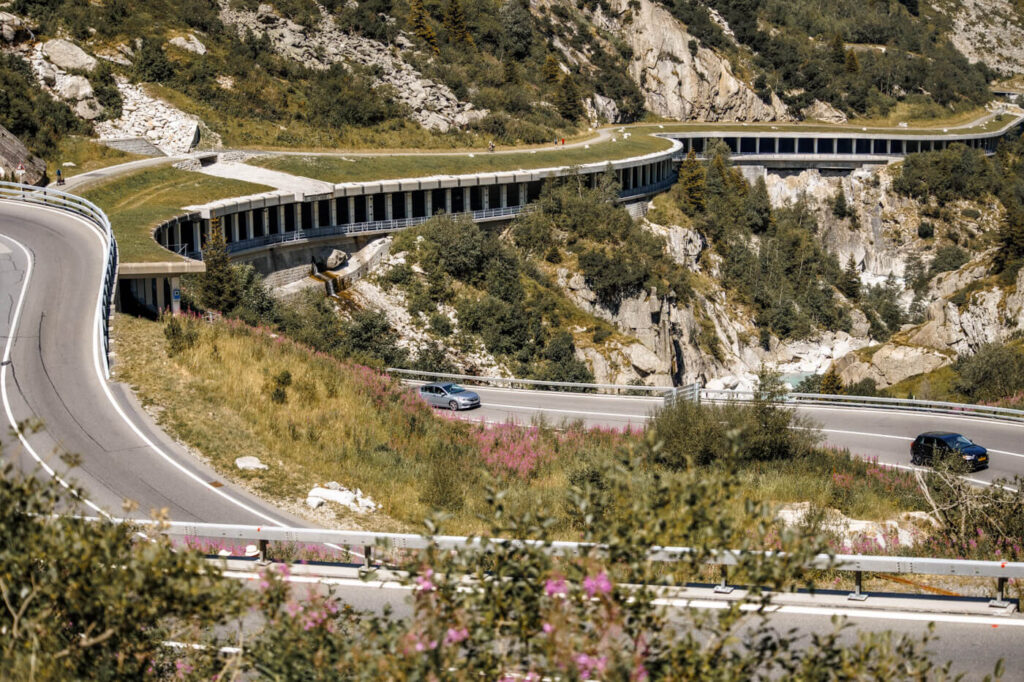
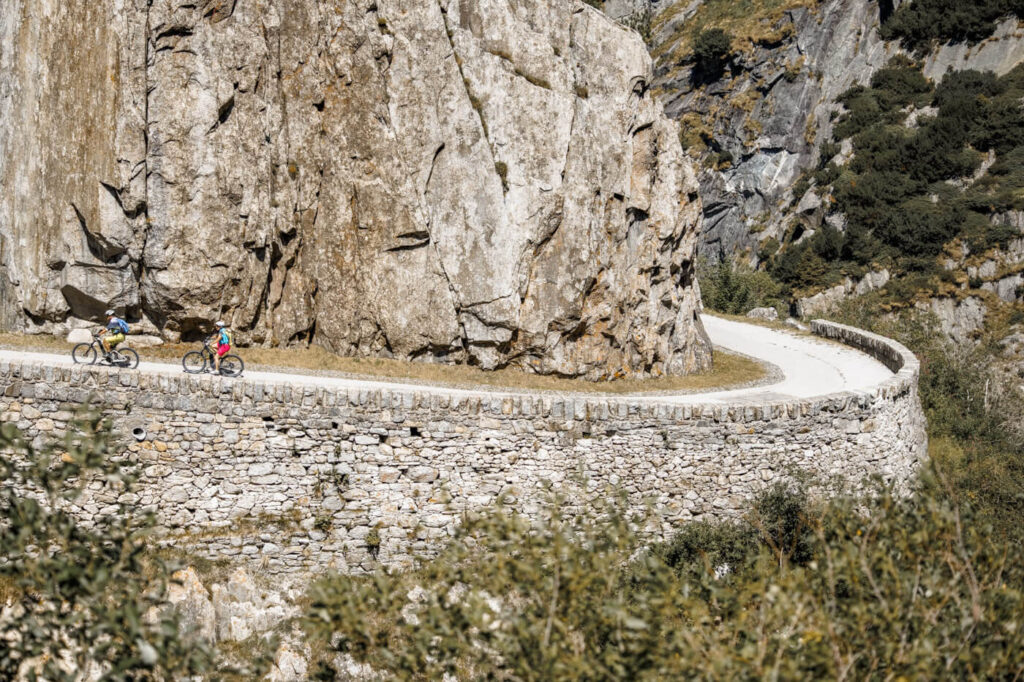
As you continue towards Andermatt, the road becomes increasingly impressive. Sections run through partially open avalanche galleries. Some have vegetation growing across their roofs, with walking and cycling paths passing above them. Elsewhere, the galleries seem almost absorbed into the steep mountainsides. Seen from a distance, it creates an unusual layered landscape. Cars travel through the galleries below while walkers and cyclists cross the green roofs above them.
Teufelsbrücke in the Schöllenen Gorge
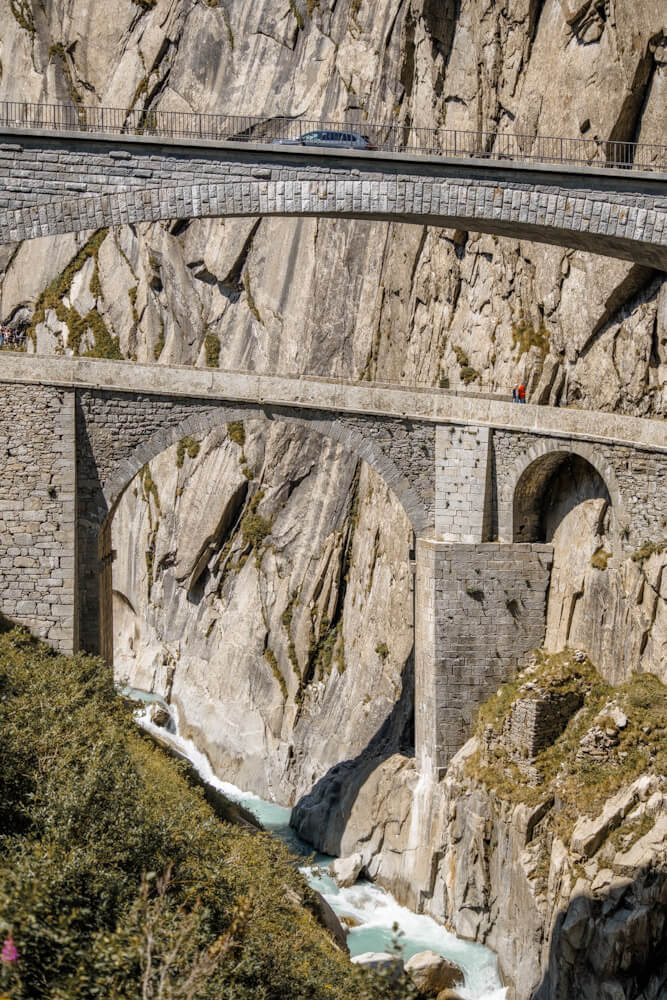
Just before Andermatt you reach the famous Teufelsbrücke, or Devil’s Bridge. You can park beside the river at the car park marked as Andermatt-Car Parkplatz on Google Maps. From here, there is a short circular walk through the Schöllenen Gorge. The moment you step out of the car, you can hear the Reuss thundering through the narrow gorge below and the bridge is already visible between the rocks.
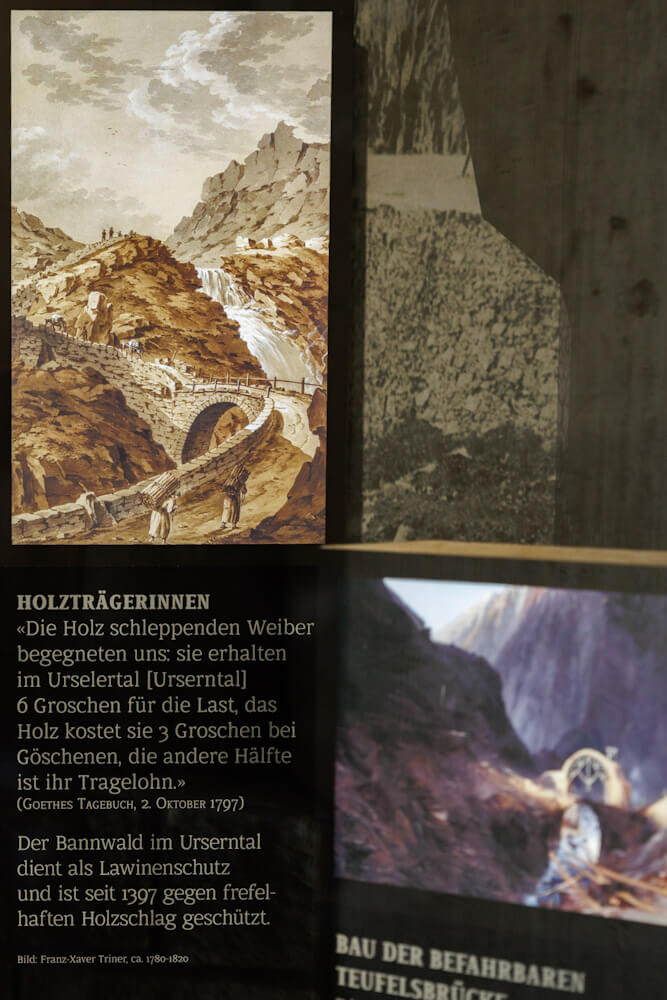
The name Teufelsbrücke comes from an old legend. Building a bridge at this spot was said to be so difficult that the people of Uri eventually asked the devil for help. He agreed to build it on the condition that he would receive the soul of the first being to cross. The villagers outsmarted him by sending a goat across first. According to the story, the furious devil then tried to destroy the bridge by throwing an enormous rock at it.
The bridge you see today is not the original medieval structure. The surviving Teufelsbrücke dates from 1830. Beside it is the newer road bridge, built in the 1950s.
Restaurant Teufelsbrücke and the Suworow monument
A small tunnel beneath the road bridge takes you to the other side of the main road. Inside are several small displays explaining more about the history of the Schöllenen Gorge and the Gotthard route.
On the other side stands Restaurant Teufelsbrücke. A building has stood here for more than a century and for many years it served as a stopping place for travellers crossing the Gotthard. The old road passed directly beside it and you can still see how tightly the road, bridge and building are squeezed into the narrow gorge. The restaurant has closed and reopened several times over the past few decades. When we visit, it is once again closed for an indefinite period.
Behind the restaurant is the enormous Suworow monument, built against the rock face. It commemorates the fighting that took place here in 1799 between Russian forces commanded by General Alexander Suvorov and French troops.
Through Andermatt and Hospental towards the Gotthard Pass
After visiting the Devil’s Bridge, continue towards the Gotthard Pass, which reaches an altitude of just over 2,100 metres. The pass is more than a geographical divide. It also marks a transition between two linguistic regions of Switzerland. To the north lies the German speaking canton of Uri. Cross the mountains and you descend into Italian speaking Ticino.
The scenery changes almost immediately after leaving the Schöllenen Gorge. The narrow rock walls open into the broad Urserental and shortly afterwards you reach Andermatt. From Andermatt, continue towards Hospental. This small village sits at a historic crossroads of Alpine routes. One road leads towards the Furka Pass while the Gotthard route continues south. The real climb begins beyond Hospental. Green slopes gradually give way to a much barer landscape where rock, grass and water dominate. Snow often remains on the surrounding peaks well into the warmer months. The first bends above Hospental also provide increasingly wide views back across the Urseren Valley. The higher you climb, the more rugged the landscape becomes.
Stop at Lago della Piazza
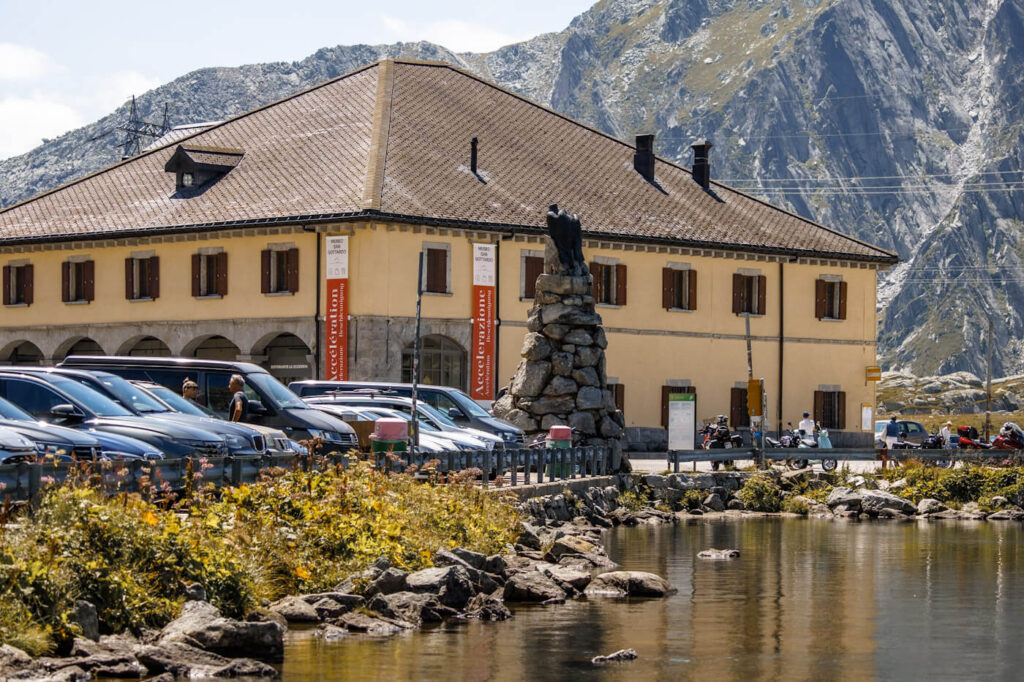
At the top of the Gotthard Pass lies the small mountain lake Lago della Piazza. It is an easy place to stop for a while before continuing towards the Via Tremola. The pass can get busy during the main travel season, but there are several places to eat around the lake. You will also find the historic hospice and the National Gotthard Museum here.
We keep things simple and eat a bratwurst beside the lake, looking out towards the mountains. On a clear day, there is not much more you need. After the drive up through the valley, suddenly you are sitting at more than 2,000 metres among bare rocks, with the lake in front of you and the Gotthard mountains surrounding you.

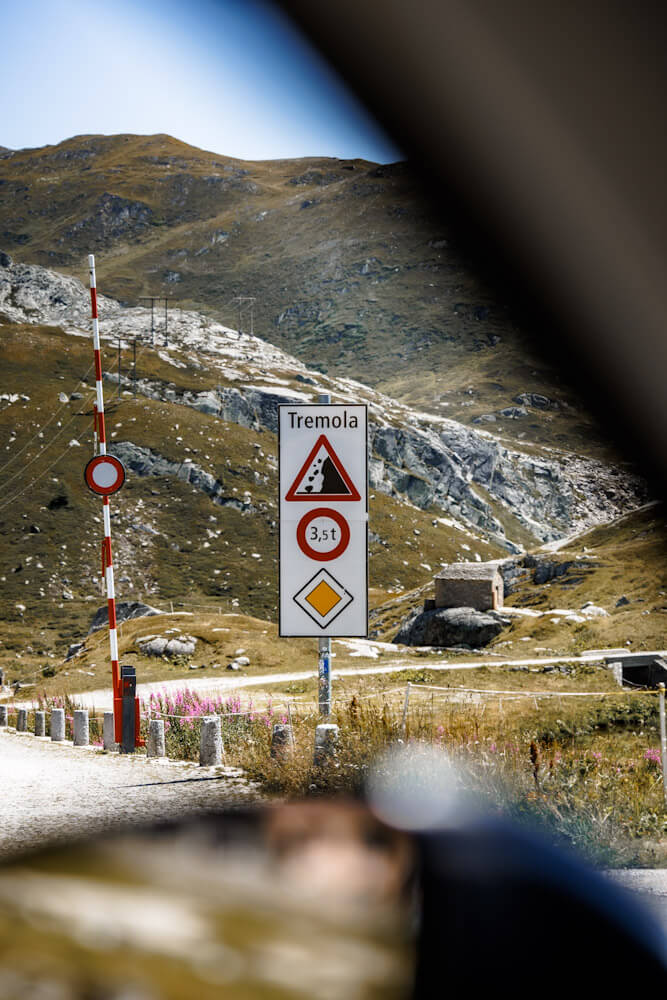
Via Tremola: 24 hairpin bends on cobblestones
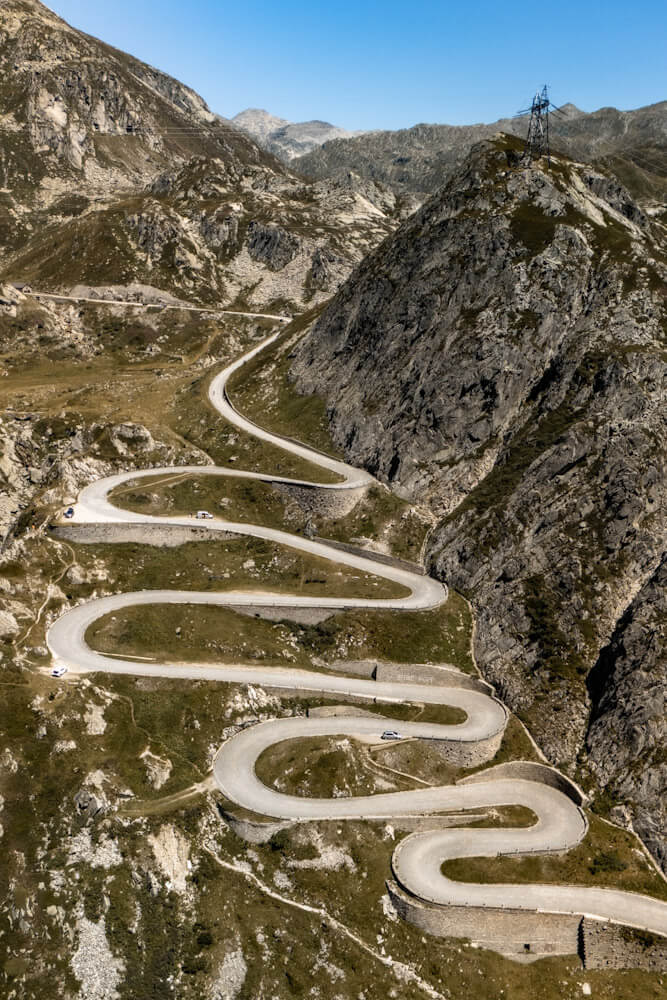
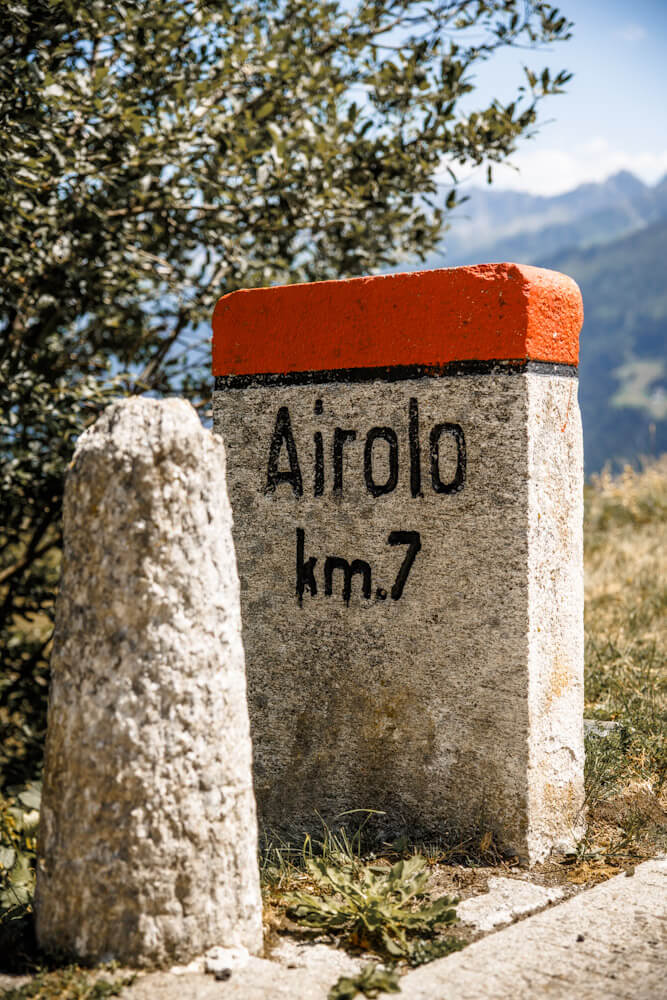
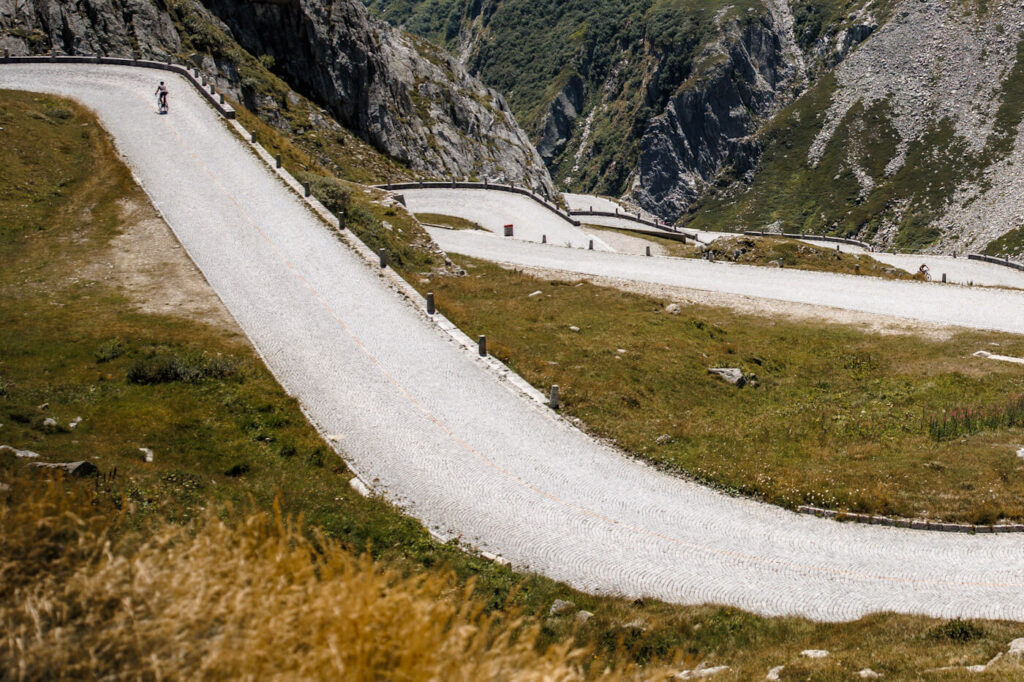
From the Gotthard Pass, you can turn onto the historic road towards Airolo, the Via Tremola. The Tremola forms part of the old Gotthard road built between 1827 and 1830. The road as you see it today largely took shape after a reconstruction completed in 1951. Much of its granite paving has survived, together with the old dry stone walls and historic kilometre markers. The Via Tremola is considered the longest historic road construction monument in Switzerland. Driving here feels very different from following a modern mountain road. The surface, stone walls and tight bends constantly remind you that this route belongs to another era of Alpine travel.
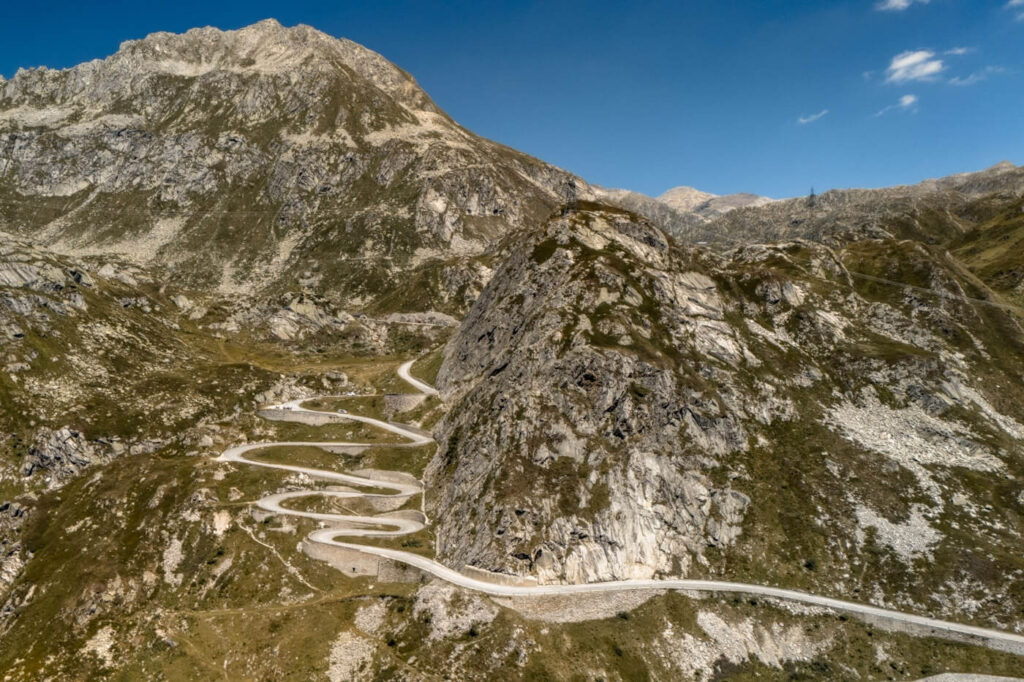
Stop to see the Via Tremola from above
The Via Tremola is beautiful from behind the wheel, but I would definitely stop a few times along the way wherever it is safe to do so. It is from above that you really appreciate how remarkably the road has been built into the mountainside. The short straight sections seem to sit on top of one another, almost like different levels, with a hairpin bend connecting them at either end. There is an even wider view from the Gotthard Pass, where you will find an official Grand Tour of Switzerland Photo Spot overlooking part of the historic road and its hairpin bends. You do not pass this particular viewpoint when driving the Via Tremola itself. Fortunately, there are several places near the beginning of the descent where you can safely stop and look down across the road and the bends below. For me, these are some of the best views of the entire route.
Arriving in Airolo and Ticino
After the final hairpin bends, the road gradually becomes less steep and you enter Airolo. This is where you really notice the contrast between the two sides of the Gotthard. A few hours earlier, you are travelling through German speaking Switzerland beside dark rock walls and the rushing waters of the Reuss. Now you are in Italian speaking Ticino, where the landscape slowly begins to feel more southern. From Airolo, you can rejoin the A2 and continue deeper into Ticino towards Bellinzona and Lugano. You can also make the Gotthard Pass part of a longer road trip through Switzerland, combining it with other mountain passes and destinations in the Swiss Alps.
How much time do you need for the Via Tremola?
You do not need an entire day to drive the Gotthard Pass and Via Tremola. The section between Andermatt and Airolo takes well under an hour if you drive straight through, although I think that rather misses the point. If you stop at the Devil’s Bridge, walk through part of the Schöllenen Gorge, have something to eat at the top of the Gotthard Pass and pull over a few times for photographs of the Tremola, allow around two additional hours. You could easily spend longer if you enjoy photography or want to explore Andermatt along the way. Rather than thinking of those hours as extra driving time, I would see the route as a destination in itself. The landscape changes constantly and the stops are what make this drive memorable.
When can you drive the Via Tremola?
The Gotthard Pass is a seasonal road. In winter, snow makes the route impassable and the pass is closed. It is generally possible to drive the route from late spring until sometime in October, but the exact opening and closing dates vary from year to year depending on snow and weather conditions. Always check shortly before your trip whether both the Gotthard Pass and the Via Tremola are open. Weather matters even when the road is accessible. In low cloud or heavy rain, I would save the drive for another day if possible. Much of its appeal comes from the mountain scenery and views across the valleys. The cobblestones of the Via Tremola can also become more slippery when wet. On a clear summer day, however, this is exactly the kind of road I would choose to drive simply for the experience.
Via Tremola or the Gotthard Road Tunnel?
If you are travelling between northern Switzerland and Ticino, there are two very different ways to cross this part of the Alps. The Gotthard Road Tunnel is the practical option. It takes you beneath the mountains and is usually the obvious choice when reaching your destination quickly matters most. The Gotthard Pass and Via Tremola turn the same journey into a scenic drive. Instead of spending the crossing inside a tunnel, you travel through the Schöllenen Gorge, stop at the Devil’s Bridge and follow the Reuss between steep rock walls. Beyond Andermatt and Hospental, you climb to more than 2,000 metres before crossing the pass and descending towards Ticino over the historic cobblestones of the Via Tremola.
Which route makes most sense depends on the weather, the season and how much time you have. Heavy traffic can also make a difference. During busy travel periods, queues sometimes form at the Gotthard Road Tunnel. When the pass is open, it is worth checking current conditions before deciding which route to take. But if the sky is clear, the Gotthard Pass is open and you are looking for a memorable mountain drive rather than simply the quickest way across Switzerland, I would choose the pass and Via Tremola every time.
Recommended places to stay close to the Gotthard Pass
If you want to spend more time in this part of Switzerland, Andermatt makes a convenient base. Staying here also gives you more freedom to drive the Gotthard Pass when the weather is at its best rather than fitting it into a longer journey. These three centrally located hotels are highly rated and offer good value for money.

Radisson Blu Hotel Reussen, Andermatt

Gasthaus Skiklub

Sonne Andermatt Swiss Quality Hotel

