During a stay at Fourvière Hôtel in Lyon you are perfectly placed to discover the highlights of Fourvière Hill. Within a few minutes’ walk you reach the impressive Basilique Notre-Dame de Fourvière, a world famous landmark that can be seen from almost every part of the city. Add panoramic views across Lyon and the remarkable Roman theatres and it quickly becomes clear why this hill is considered the birthplace of the city.
Read this article in DutchFourvière, the birthplace of Lyon
The story of Lyon begins here on Fourvière Hill. In 43 BC the Romans founded Lugdunum, a settlement that grew into the capital of Roman Gaul and one of the most important cities in the Roman Empire north of the Alps. Their choice of location was far from accidental. From the hill they had sweeping views of the surrounding area and of the Rhône and Saône rivers. This strategic position made Fourvière an ideal place for trade, administration and defence. From here Lugdunum flourished and laid the foundations for the Lyon you see today.
Fourvière remained an important place long after the Roman period. Over the centuries monasteries, chapels and churches were built here, gradually turning the hill into the religious heart of Lyon. It earned the nickname la colline qui prie, meaning the hill that prays, in contrast to the nearby Croix-Rousse district, known as la colline qui travaille, or the hill that works. Even today the atmosphere here feels noticeably calm. While everyday life continues below in the city centre Fourvière remains a place where history, culture and faith have come together for centuries.


Staying in a former convent
Fourvière’s religious heritage is still visible everywhere today. It is reflected not only in the basilica and chapels but also in Fourvière Hôtel, where I stayed during my visit to Lyon. The hotel occupies the former Couvent de la Visitation, a convent dating from 1854. It was designed by the architect Pierre-Marie Bossan, who a few years later also created the design for the Basilique Notre-Dame de Fourvière.
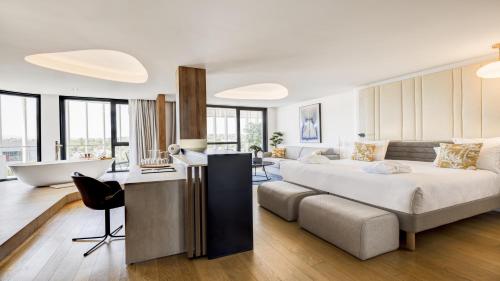
Much of the building’s original character has been preserved during its transformation into a hotel. The reception is located in the former chapel while the long corridors, symmetrical layout and peaceful courtyard still reflect the history of the building. With comfortable rooms, a spa, an outdoor swimming pool and an excellent restaurant this elegant four star hotel offers everything you need for a relaxing stay.
Fourvière Hôtel is an excellent base for exploring Fourvière Hill. From the hotel it is only a short walk to both the Roman theatres and the basilica. The historic funicular railway is also nearby, making it quick and easy to reach Vieux Lyon. If you are travelling to Lyon by car this is a particularly convenient place to stay. You can park at the hotel and avoid driving through the narrow streets of the old town before exploring the city on foot or by public transport.


Basilique Notre-Dame de Fourvière
It is only a few minutes’ walk to the Basilique Notre-Dame de Fourvière. Built between 1872 and 1896 this striking white basilica looks more like a palace than a church. Its construction is closely linked to the history of Lyon. For centuries the people of Lyon have honoured the Virgin Mary as the city’s protector and believe that her intervention spared the city during several epidemics and wars. When the Franco Prussian War broke out in 1870 and Prussian troops never reached Lyon the city’s residents decided to build a grand basilica in her honour as a gesture of gratitude.
Architect Pierre Bossan deliberately combined Romanesque, Byzantine and Gothic influences, giving the basilica a distinctive appearance unlike many other churches in France. Four tall towers rise from each corner of the building while a gilded statue of the Virgin Mary crowns the top, visible from far across the city.
The interior is just as impressive. Almost every surface is decorated with colourful mosaics, marble, gold leaf and stained glass. While many churches have a restrained appearance Notre-Dame de Fourvière is rich in colour and symbolism. Be sure to visit the crypt beneath the basilica as well. Dedicated to Saint Joseph it is almost as large as the upper church but has a much simpler and more understated atmosphere. Even if churches are not usually part of your travel plans the basilica is well worth a visit, if only to experience the striking contrast between the richly decorated interior above and the quiet simplicity of the crypt below.


Chapelle Saint-Thomas
Before stepping inside the basilica take a moment to visit the smaller and much older Chapelle Saint-Thomas. The Virgin Mary has been honoured on this site since the twelfth century. Although the chapel has been rebuilt several times over the centuries it remains an important place of pilgrimage and is considered the historic predecessor of the basilica.
The chapel also plays an important role in the story behind Lyon’s famous Fête des Lumières. On 8 December 1852 the people of Lyon placed candles in their windows to honour the Virgin Mary. What began as a spontaneous tribute gradually developed into an annual tradition and eventually became one of the world’s best known light festivals.


One of the best views in Lyon
Right in front of the basilica is a large terrace with sweeping views across Lyon. On a clear day you can watch the Saône winding past Vieux Lyon while the Rhône flows through another part of the city. Between the two rivers lies Presqu’île, the peninsula that forms Lyon’s modern city centre. In the distance you can see the hills of Croix-Rousse and on exceptionally clear days even the snow covered summit of Mont Blanc. It is the kind of view that invites you to pause for a while. Not only because it is impressive but also because it offers a clear picture of how Lyon has grown and evolved over the centuries.

Lyon’s little Eiffel Tower
From the terrace you can hardly miss the Tour métallique de Fourvière. Thanks to its metal framework it is often referred to as Lyon’s little Eiffel Tower. Built in 1894 and inspired by the famous Eiffel Tower in Paris the structure now serves as a telecommunications tower. Although it is not open to visitors it remains one of the most recognisable landmarks on Fourvière Hill.


Two thousand years of history in the Roman theatres
Between the basilica and Fourvière Hôtel you suddenly step into a completely different chapter of Lyon’s history. Here you will find the large Roman theatre, one of the oldest in France. It was built around 15 BC shortly after the founding of Lugdunum. At its height it could accommodate around 10,000 spectators who gathered here for theatrical performances, music and public events.
Right next to it stands the smaller Odéon. This theatre was used for musical performances, poetry readings and political gatherings. Although more modest in size it is one of the best preserved Roman odeons in Europe. Remains of its marble floors and decorative features still offer a glimpse of how elegant the building once was.
Just a short walk away are the remains of an early Christian basilica. Built in the sixth century on top of a Roman necropolis it reflects the transformation of Fourvière into the religious heart of Lyon after the Roman period. While only the foundations and archaeological remains survive they provide a fascinating insight into the long history of the hill.
Every summer the Roman theatres become the setting for Les Nuits de Fourvière, an international cultural festival that has been held since 1946. Over several weeks the venue hosts concerts, theatre performances, dance productions, circus acts and other cultural events. The festival attracts thousands of visitors each year and is one of Lyon’s leading cultural highlights.


Taking the funicular to Vieux Lyon
From Fourvière it takes just a few minutes to reach Vieux Lyon on the historic funicular, affectionately known by locals as la ficelle. This hillside railway has been carrying passengers between the hill and the old town since the early twentieth century. Lyon once had five funicular lines but today only two remain in operation on Fourvière Hill. If you prefer to walk that is a rewarding option too. A network of steep streets and stairways leads down to Vieux Lyon in about twenty minutes. Along the way you are treated to regular glimpses of the city unfolding below.

Dining with a view at Restaurant Bulle
After an afternoon exploring the history of Fourvière I settle in for dinner at Restaurant Bulle, located in the historic Maison Carrée beside the basilica. Built between 1859 and 1863 the building originally served as the residence for the chaplains of the Fourvière sanctuary. Like both the basilica and Fourvière Hôtel the Maison Carrée was designed by the architect Pierre-Marie Bossan. The restaurant’s bistronomic concept was created by Michelin starred chef Guy Lassausaie with seasonal ingredients taking centre stage. The spacious terrace overlooks Lyon making it a wonderful place to end the day.


Discover more of Lyon
Fourvière can easily keep you occupied for an afternoon but it is only the beginning of what Lyon has to offer. Be sure to spend some time exploring Vieux Lyon where narrow streets, hidden traboules, the city’s famous hidden passageways, and charming squares transport you back to the Renaissance. It is the perfect complement to a stay on Fourvière Hill.
Recommended places to stay in Lyon
These three centrally located hotels in Lyon are highly rated and offer good value for money.

Tribe Lyon Croix Rousse
Golden Tulip Lyon Ouest Techlid - Hotel And Spa

Fourvière Hôtel

